China Top 10 Windows Manufacturers for Global Buyers
China’s window industry has become a serious sourcing option for international developers, distributors, and renovation companies. This guide examines China’s top windows manufacturers through practical buyer criteria, including thermal performance, air tightness, water resistance, certifications, production capacity, and export experience.
The International Energy Agency’s Buildings report states that buildings consume about 30% of global final energy. The U.S. Department of Energy also reports that windows can account for 25% to 30% of residential heating and cooling energy use. These figures explain why frame materials, glazing systems, spacers, and installation quality deserve careful attention. A low purchase price means little if condensation appears along the inner edge every winter.
Building scientist Joseph Lstiburek offers a useful warning: “A window is a hole in the wall.” His phrase is simple. The details are not. This review compares leading Chinese suppliers against measurable requirements, rather than attractive catalogs alone. It considers aluminum, uPVC, wood-aluminum, curtain wall, and energy-efficient glazing solutions. It also highlights testing evidence, factory audits, quality control, and communication practices for global buyers.
Some manufacturers may look similar on paper. They are not always equal in production discipline or after-sales support. Buyers should verify laboratory reports, sample dimensions, hardware brands, coating specifications, and packaging methods before signing contracts. We also recognize a limitation: rankings can change with market conditions, project requirements, and verified factory performance. Still, this selection offers a practical starting point for finding reliable top windows suppliers in China.
Industry Context: Buildings Use ~30% of Global Energy (IEA, 2022)
China Top 10 Windows Manufacturers for Global Buyers
Buildings consume approximately 30% of global energy, according to the IEA’s 2022 Global Status Report for Buildings and Construction. Windows influence this demand through heat transfer, air leakage, daylight, and solar gain. A poorly sealed frame can create a cold perimeter around a room. That small detail increases heating or cooling loads.
For global buyers comparing China’s top ten window manufacturers, product evidence matters more than catalog claims. Request tested U-values, solar heat gain coefficients, air-tightness results, and water penetration data. EN 14351-1, ASTM E283, and ISO 10077 provide useful reference points, depending on the project market. The right glazing also depends on climate. Low-emissivity double glazing may suit many temperate buildings, while hot regions often need stronger solar control.
The IEA reports that building operations produce about 26% of global energy-related emissions.
UNEP’s 2023 Global Status Report adds that the buildings and construction sector represented about 37% of global energy-related and process CO2 emissions in 2022.
These figures make window procurement an energy decision, not merely a styling choice. Still, performance labels can mislead when installation quality is ignored. Ask for corner samples, gasket details, drainage paths, and site-adjustment guidance. Test reports are valuable. They are not the whole building.
Market Scope: China’s Window Exports by HS Codes (UN Comtrade, 2023)
China Top 10 Windows Manufacturers for Global Buyers
Market Scope: China’s Window Exports by HS Codes (UN Comtrade, 2023)
A credible top-10 window shortlist should begin with trade data, not promotional claims. UN Comtrade records China’s 2023 exports through HS code families linked to window products. Common references include HS 3925 for plastic building elements, HS 4418 for wooden joinery, HS 7610 for aluminium structures, and HS 7308 for iron or steel structures. Classification can vary by material, design, and customs interpretation.
This matters for global buyers. A shipment may contain complete windows, frames, or related structural parts. The data does not always isolate finished windows. That is a weakness. I would compare China’s export value, quantity, destination markets, and unit values before contacting suppliers. Sudden unit-price differences may reflect glass specification, frame material, packaging, or mixed product categories.
Factory verification still requires practical evidence. Ask for recent export records, production photos, material certificates, test reports, and sample measurements. Check whether the factory controls extrusion, coating, glazing, and final assembly. A low HS-based price can look attractive. It may exclude hardware, protective packing, or upgraded glass. Small details matter. Buyers should also confirm local energy standards, wind-load requirements, installation methods, and warranty terms before ranking manufacturers. Trade data is useful, but it should support direct verification rather than replace it.
Ranking Framework: U-Value, Air Leakage, Certifications, Capacity, and Exports
China Top 10 Windows Manufacturers for Global Buyers
A credible ranking starts with thermal performance, not showroom appearance. The IEA’s Global Status Report for Buildings and Construction reports that buildings consume about 30% of global energy. Therefore, window U-value deserves heavy weighting. Lower U-values indicate better insulation. Buyers should compare tested whole-window results, not glass-only claims. Results should state frame, spacer, glazing, and test conditions clearly.
Air leakage is another practical filter. Testing under 75 Pa can reveal weak seals around opening sashes. Lower leakage values generally support comfort and reduce uncontrolled heat loss. Certification records should match the destination market. Useful evidence may include product testing under EN 14351-1, AAMA/WDMA/CSA 101/I.S.2/A440, or equivalent standards. ISO 9001 can support factory consistency, but it does not prove every window performs well. That distinction is often missed.
Production capacity needs physical evidence. Assess extrusion lines, glass processing equipment, laboratory facilities, annual output, and quality staff. Export capability should be checked through shipment history, destination markets, packaging samples, and documented lead times. Public trade datasets can help, although customs records may combine different product categories. A sensible ranking might assign 30% to U-value, 20% to air leakage, 20% to certifications, 15% to capacity, and 15% to verified exports. The weighting is not perfect. Coastal corrosion, extreme climates, and installation quality can change the final result. Independent test reports and recent factory audits remain essential.
Top 10 Chinese Window Manufacturers: Products, Certifications, and Markets
China Top 10 Windows Manufacturers for Global Buyers
This guide profiles ten Chinese window manufacturers serving residential, commercial, and industrial projects worldwide. Their product ranges commonly include thermal-break aluminum windows, uPVC systems, sliding doors, curtain walls, and fire-rated assemblies. Some also produce customized glass packages for coastal, high-altitude, or heavily polluted environments.
Product details matter more than factory size. Buyers should review frame thickness, glass configuration, hardware origin, drainage design, and tested air-tightness. Many manufacturers operate under ISO 9001 quality systems. Depending on the target market, products may also carry CCC, CE, NFRC-related ratings, or other regional approvals. Certification scope must be checked carefully. A factory certificate does not automatically certify every window model.
These manufacturers export to North America, Europe, Australia, the Middle East, Africa, and Southeast Asia. Export experience can reveal useful habits, such as stronger packaging, clearer labeling, and better installation guides. Ask for recent project references, laboratory reports, production photos, and sample corners before placing a large order. Small sample checks often expose larger problems. No ranking is perfect. Some suppliers communicate well but provide limited testing evidence, while others offer strong engineering but slower support. Buyers should compare warranty terms, replacement procedures, lead times, and local building requirements before signing a contract. A well-made window can still fail when installation details are ignored.
China Top 10 Windows Manufacturers for Global Buyers
Products, Certifications, and Target Markets
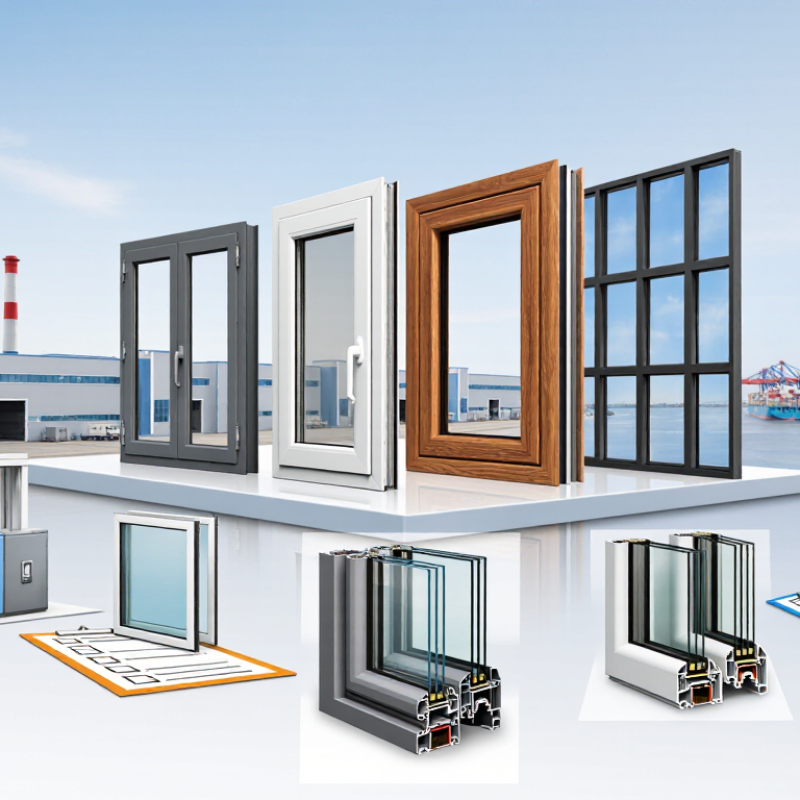
This chart compares major export markets by the number of widely referenced window standards and compliance frameworks used in product specifications. The figures are framework counts, not market share or manufacturer rankings. Typical product categories include aluminium windows, uPVC windows, timber-aluminium windows, curtain wall systems, sliding doors, and energy-efficient glazing.
Buyer Checklist: MOQ, Lead Time, Warranty, Testing, and Total Cost
China Top 10 Windows Manufacturers for Global Buyers
Buyer Checklist: MOQ, Lead Time, Warranty, Testing, and Total Cost
Comparing the top ten manufacturers requires more than checking catalog photos. Ask for the exact MOQ for each window style, glass option, and finish. A low MOQ may still hide higher packaging or tooling charges. Request a written lead-time schedule, including production, inspection, and shipping preparation. Add buffer time for revised drawings and public holidays. Delays happen.
Warranty terms should state coverage, exclusions, claim procedures, and replacement responsibility. Do not accept vague promises such as “long-term support.” Confirm whether hardware, seals, glass, and coating have different warranty periods. Ask for test reports covering air infiltration, water resistance, wind load, thermal performance, and safety glass requirements. Reports should match the proposed profile and configuration, not an older model.
The full cost includes samples, engineering changes, crates, inland transport, duties, installation materials, and possible rework. Compare landed cost, not only the factory quotation. I have seen attractive prices become expensive after missing accessories were added. A spreadsheet helps, but it is never perfect. Verify dimensions through approved drawings and pre-shipment inspection. Check communication speed too; unclear replies often signal future coordination problems. One small sample corner can reveal more than a polished presentation.