

wool blend felt sits between traditional craft material and practical industrial textile. It combines wool with synthetic or plant-based fibers, creating a surface that can feel warm, dense, and slightly springy. The exact balance changes its strength, texture, price, and environmental profile. That difference matters.
Textile historian Mary Burkett described felt as “the oldest form of textile known to man.” Her observation helps explain its lasting appeal. Wool fibers contain microscopic scales that interlock under pressure, moisture, and controlled agitation. Added fibers can improve color stability, reduce shrinkage, or make the sheet easier to cut. They can also change how the material behaves near heat, moisture, and repeated friction.
In real workshops, wool blend felt appears in acoustic panels, garment details, craft kits, furniture pads, packaging, and decorative wall pieces. A designer may choose a firm sheet for a laptop sleeve, then select a softer grade for a child’s mobile. The material cuts cleanly with a sharp blade. Its edges may still show compression marks or loose fibers. Not always.
This article examines how wool blend felt is made, how its fiber ratio affects performance, and where it works best. It also considers limitations that product descriptions sometimes overlook. A felt sheet may look dense but perform poorly under constant abrasion. A bright color may fade beside a sunny window. Careful testing remains necessary. That sounds simple. It is not. Understanding these details leads to better purchasing decisions, more durable designs, and fewer disappointing results.
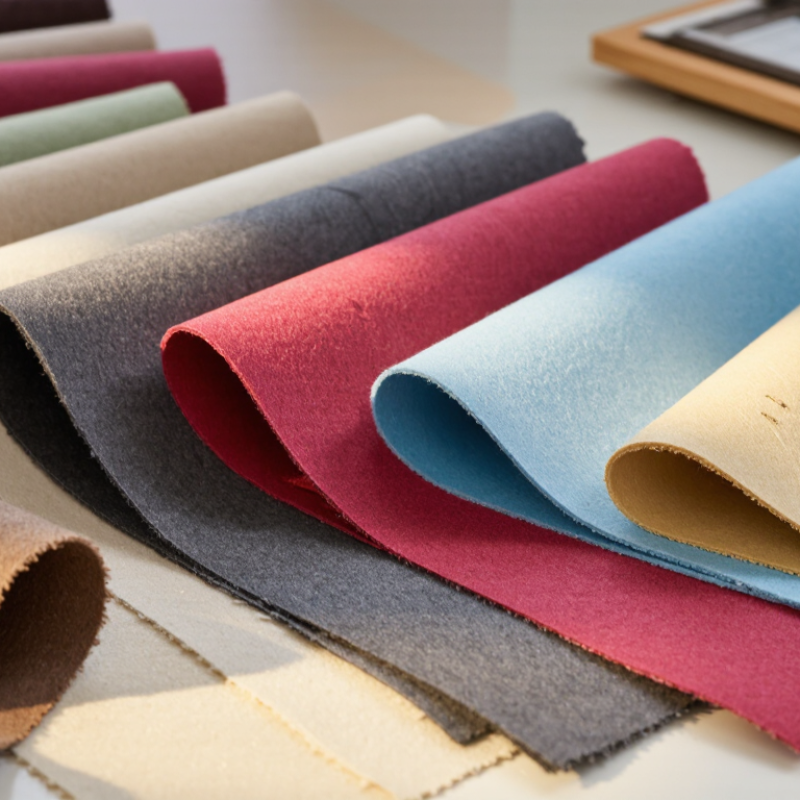
Wool blend felt is a nonwoven textile made from wool mixed with other fibers, such as polyester, viscose, or recycled fibers. Heat, moisture, pressure, or mechanical needling locks the fibers into a compact sheet. The wool portion provides natural crimp and resilience. The added fibers adjust strength, price, surface feel, or dimensional stability.
Basic characteristics depend on the blend ratio and manufacturing process. Wool can absorb moisture vapor while still feeling relatively dry. Under standard textile testing conditions, wool commonly shows about 14–18% moisture regain. It also offers useful thermal and acoustic insulation because its crimp traps small pockets of air. However, felt is not automatically waterproof or flameproof. Performance requires laboratory testing, often against standards such as ASTM D737 for air permeability or ISO 11092 for thermal resistance.
Scale matters. Textile Exchange’s Materials Market Report 2024 estimated global fiber production at about 124 million tonnes in 2023, while wool represented roughly 1% of total output. This small share can make wool blends attractive for products needing wool’s tactile warmth with more controlled material costs. In practice, dense felt works well for desk pads, gaskets, acoustic panels, clothing details, and protective linings. I have found that surface appearance can be misleading. A soft felt may wear quickly, while a firm sheet can feel less comfortable. Testing thickness, density, recovery, and edge stability remains essential.
| Data Dimension | Typical Information | Definition and Practical Significance |
|---|---|---|
| Material Definition | Nonwoven felt made from wool combined with one or more other fibers | Wool blend felt is produced by consolidating fibers through heat, moisture, pressure, and mechanical action rather than weaving or knitting yarns into a regular fabric structure. |
| Common Fiber Blends | Wool with polyester, rayon, acrylic, nylon, or other synthetic or regenerated fibers | The exact blend depends on the intended performance. Wool contributes warmth, resilience, and a natural surface, while additional fibers can improve strength, color consistency, dimensional stability, or cost efficiency. |
| Wool Content | Varies widely, commonly from a small percentage to more than 50% | There is no single standard wool percentage for all wool blend felts. The fiber ratio should be checked on the product specification or label because it directly affects feel, performance, and care requirements. |
| Fabric Structure | Dense, fibrous, nonwoven structure | Because the fibers are entangled and compressed, felt does not normally have a distinct warp-and-weft direction. This gives it useful cutting flexibility and helps reduce fraying at the edges. |
| Available Thickness | Often approximately 1–10 mm; specialty grades may be thinner or thicker | Thin felt is suitable for crafts, liners, and light insulation, while thicker felt is better for padding, sound absorption, protective inserts, and structural or decorative applications. |
| Typical Weight | Commonly about 150–1,000 g/m², depending on thickness and density | Weight is not fixed across all products. A higher basis weight generally indicates a denser or thicker sheet, but the relationship also depends on fiber type and manufacturing method. |
| Surface Appearance | Soft, matte, slightly fibrous, and available in many solid colors | The surface can range from smooth and compact to visibly fuzzy. Wool fibers typically provide a warm, natural texture, while synthetic fibers can produce a more uniform finish. |
| Thermal Performance | Good insulation relative to its thickness | The entangled fiber network traps air, which helps slow heat transfer. Wool also retains useful insulating properties in moderately damp conditions, although wet felt can lose some thermal efficiency. |
| Acoustic Performance | Can help absorb and diffuse sound, especially in thicker or denser constructions | Felt can reduce reflections and high-frequency noise in interior panels, desk screens, wall coverings, equipment enclosures, and other sound-management applications. |
| Moisture Behavior | Wool can absorb moisture vapor without immediately feeling wet | Wool fibers are hygroscopic, but the overall moisture response depends on the blend, density, finish, and environmental conditions. Felt should not be treated as waterproof unless specifically engineered for that purpose. |
| Flame Behavior | Wool is naturally less readily ignited than many common fibers; blend performance varies | Wool can char and self-extinguish more readily than many petroleum-based fibers, but the final product must be tested as a complete material. Fire performance should be confirmed through applicable test data rather than assumed from fiber content alone. |
| Dimensional Stability | Generally stable when properly manufactured and handled | Excessive heat, agitation, or moisture can cause wool-containing felt to shrink, distort, or change surface texture. Synthetic fibers may improve stability, but they do not eliminate the need for suitable processing conditions. |
| Cutting and Processing | Can be cut with scissors, rotary cutters, dies, or industrial cutting equipment | Felt is convenient for prototypes and production parts because it can be cut into simple or complex shapes. Laser or heated cutting may alter the edge and should be evaluated for the specific fiber blend. |
| Edge Fraying | Usually lower than that of woven fabrics | The nonwoven structure generally allows clean cut edges without conventional hemming. Highly flexible, loosely consolidated, or heavily handled grades may still shed fibers or require edge treatment. |
| Common Decorative Uses | Craft projects, ornaments, appliqué, toys, banners, and interior accents | The material is easy to cut, sew, glue, and layer. Its color range, soft hand, and matte appearance make it suitable for both educational projects and decorative design work. |
| Common Functional Uses | Gaskets, seals, washers, pads, liners, furniture components, and protective packaging | Felt can provide cushioning, vibration damping, surface protection, and limited sealing. The appropriate grade should be selected according to compression, temperature, chemical, and wear requirements. |
| Interior and Acoustic Uses | Wall panels, ceiling elements, room dividers, desk screens, and upholstery details | Thicker wool blend felt can combine visual warmth with sound-management benefits. Performance depends on thickness, air gaps, mounting method, and the acoustic properties of the complete assembly. |
| Maintenance | Usually requires gentle cleaning and protection from excessive heat and agitation | Loose dirt can often be removed by careful vacuuming or brushing. Washing instructions vary by product, and wool-containing felt may shrink or deform if washed or dried incorrectly. |
| Key Selection Factors | Fiber ratio, thickness, density, color, stiffness, finish, and intended environment | Selection should also consider abrasion, compression recovery, moisture exposure, temperature, flame requirements, cutting method, and whether the material will contact skin, food, or sensitive surfaces. |
Note: Specifications such as wool percentage, thickness, basis weight, colorfastness, acoustic performance, and flame behavior vary by product construction. Always verify the technical data for the specific wool blend felt being used.
*$250 Off/Window $500 Off/Door. Minimum of 4 Windows. Max savings not to exceed $2,500. Must present coupon at time of estimate. Some restrictions apply. Cannot be combined with any other offers. Call or see the website for details. www.mpwindowsanddoors.com. Offer Expires 9/30/25. CSLB# 778326. 100% Employee Owned.
Contractor's License CSLB #778326.