

Choosing the top Theater Seating Manufacturer in China takes more than comparing catalog prices. A convincing supplier must prove that its seats work in real venues, from compact lecture halls to large auditoriums. Look closely at frame construction, foam recovery, upholstery seams, aisle access, and replacement-part availability. Ask for test reports and project references, then confirm that the examples match your venue’s capacity and use. A glossy showroom chair tells only part of the story.
Theater consultant Richard Pilbrow’s audience-centered design approach offers a useful reminder: “A seat should support the performance without calling attention to itself.” This is a paraphrase, not a verified verbatim quotation. In practice, that means checking sightlines, comfort during long performances, and whether seat rows remain easy to clean and maintain. Small details matter. A loose armrest can become a repeated complaint.
This guide compares manufacturers through practical evidence: production capability, customization, quality control, delivery planning, and after-sales support. It also considers what buyers can verify during a factory visit, such as weld consistency, upholstery samples, and the way finished seats are packed. No single company is automatically the best for every project. The right choice depends on the building, audience, budget, and service expectations. Some details may still be hard to judge from public information alone; that deserves honest scrutiny, not confident guesswork.
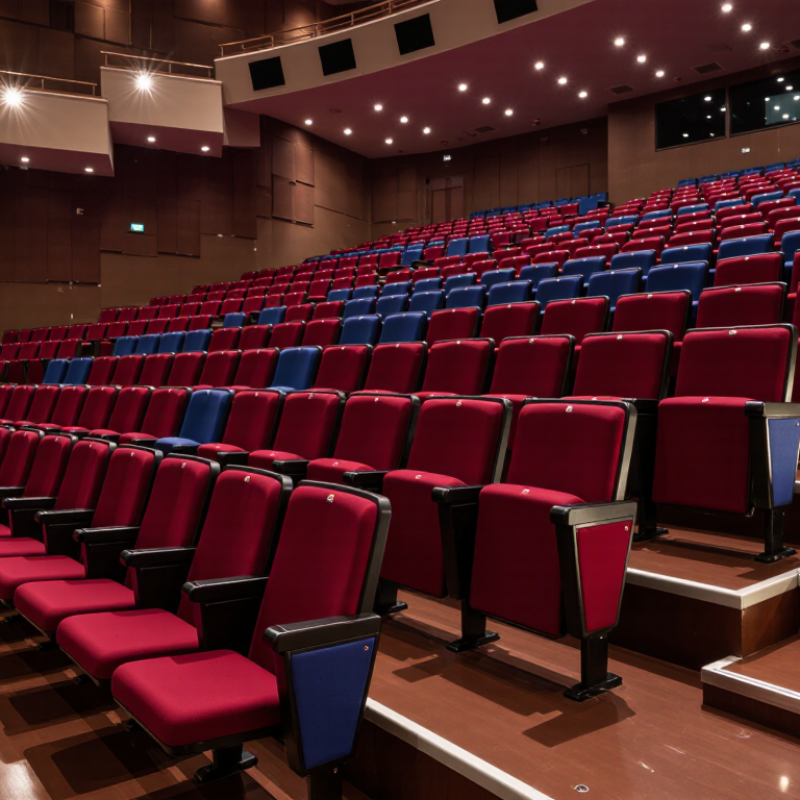
“Top manufacturer” depends on the job. An OEM producer builds to a buyer’s drawings and specifications. An ODM supplier can also develop seat designs, mechanisms, and finishes. For theaters, that distinction matters: a compact seat for a black-box venue differs from a wide, upholstered seat in a large auditorium. China’s National Bureau of Statistics reported RMB 655.7 billion in operating revenue for furniture manufacturers above designated size in 2023. This is a broad sector figure, not theater-seat sales, so it should not be treated as a market ranking.
Project-supply partners handle more than production. They may review seating plans, confirm row spacing, coordinate aisle ends, and deliver seats in installation order. Buyers should check the supplier’s drawings, load and durability test records, material samples, and quality-control process. Ask who manages site measurements and replacement parts, too. A polished sample is useful, but it does not prove consistent production across hundreds of seats. That gap deserves attention.
A top theater seating manufacturer should be judged by what it can consistently produce, not by its largest advertised number.
Ask for monthly capacity and clarify which products that figure covers. A line making standard auditorium chairs may work differently from one handling custom row layouts, writing tablets, or accessible seating. Request recent production schedules, not just a factory’s total floor area. Can the team show how it manages frame welding, upholstery, and final inspection across a typical order?
Small details matter. A delayed fabric shipment can disrupt an otherwise capable line.
Lead time needs the same careful reading. Ask when the clock starts: after deposit, approved drawings, or confirmed materials? Compare the quoted schedule with records from completed orders, and check how changes affect delivery. A clear answer is more useful than an impressive promise.
Export experience also deserves evidence. Request anonymized shipment records, destination regions, packing photos, and references from comparable projects. Check whether the supplier can explain container loading and protect seat backs and armrests from transit damage.
I would not treat any single metric as proof. Capacity may be overstated, and an export list may say little about consistency. A useful comparison weighs all three measures against the size, specification, and delivery needs of your project.
EN 1021-1 and EN 1021-2 examine how upholstered seating responds to two small ignition sources. Part 1 uses a smouldering cigarette; Part 2 uses a small flame representing a match. In a controlled laboratory, technicians test a prepared upholstery composite, not just a fabric swatch. The cover, foam, seams, and construction can all affect the result. Small details matter.
The two tests are not interchangeable. A material may resist a glowing cigarette but still ignite when exposed to a flame. Technicians observe whether smouldering or flaming develops and record the outcome against the standard’s criteria. These tests help buyers compare seating materials, but they do not predict every fire scenario or prove that an entire venue is fire-safe. That distinction is easy to overlook.
Tips: Ask for reports covering the exact fabric-and-foam combination used in production. Check that seams and any interlayers match the tested sample. If a component changes, request guidance from a qualified testing laboratory; a similar-looking replacement may behave differently. Verification can feel tedious, but it prevents avoidable assumptions.
For theater seating, a foam label or fabric specification cannot prove acoustic performance. ISO 354:2003 measures sound absorption in a reverberation room by comparing reverberation time before and after seats are installed. The room’s volume and measured decay times are used to calculate the added equivalent absorption area.
In a simplified Sabine calculation, a 200 m³ room changing from 2.0 seconds to 1.5 seconds represents about 5.3 m² of added absorption.
This is an illustrative calculation, not a product benchmark.
The result describes the tested seating arrangement, not automatically one chair. Seat spacing, upholstery, exposed backs, and mounting can change the outcome. A careful report should state the seat count, layout, test conditions, and whether the seats were empty or occupied. ISO 11654:1997 provides a related framework for expressing absorption as a single-number rating, but that rating does not replace the underlying test data.
Useful comparison begins with the full report. Small setup differences matter.
For buyers assessing a theater seating manufacturer, independent laboratory results are more useful than unsupported claims. Still, one reverberation-room value cannot predict every auditorium. Room finishes and audience occupancy also shape the final acoustics.
ISO references: ISO 354:2003, Acoustics—Measurement of sound absorption in a reverberation room; ISO 11654:1997, Acoustics—Sound absorbers for use in buildings.
For a theater seating buyer, ISO certificates can make supplier checks more structured, but they do not prove every seat will perform well. ISO 9001:2015 indicates a quality management system with defined processes for review, production control, and corrective action. Ask for the certificate, then check its validity, covered manufacturing site, and scope. Does it cover theater seating production, or a different activity? That distinction matters. A current certificate is useful, but paperwork is only a start. Inspect sample records for frame dimensions, weld checks, upholstery batches, and final function tests.
ISO 14001:2015 focuses on environmental management. It can help buyers assess how a factory identifies impacts, sets controls, and tracks improvement. Request evidence linked to actual production: waste-sorting logs, chemical-handling procedures, energy targets, and records of corrective actions. Compare documents with the workshop floor. Are labeled bins used? Are material containers closed? Small details reveal whether procedures are practiced or simply filed. Look closer. Certification does not certify a chair as low-impact or guarantee consistent delivery. Pair document checks with a site assessment, product testing, and clear acceptance criteria. Ask what failed in the last audit and what changed afterward. A candid answer may be more useful than a perfect-looking folder.
Use this evidence-based checklist to compare theater seating suppliers. ISO management-system certification can support supplier verification, but it does not by itself certify a seating product or establish which manufacturer is the best.
| Verification Area | Relevant Standard Reference | Evidence to Request | Practical Verification | What It Helps Assess |
|---|---|---|---|---|
| Quality management system | ISO 9001:2015, clauses 4.4 and 9.2 | Current certificate, certification scope, covered manufacturing site, and recent internal or external audit records. | Check that the certificate is valid, applies to the actual production site, and covers relevant manufacturing activities. Confirm its status with the issuing certification body or an appropriate certificate database. | Whether documented quality processes and auditing are in place. |
| Supplier and material controls | ISO 9001:2015, clause 8.4 | Approved supplier controls, incoming inspection records, material specifications, and traceability records for items such as frames, upholstery, foam, and fasteners. | Trace a selected material batch from purchasing records through receipt, inspection, and production use. | How externally supplied materials and services are controlled. |
| Production consistency | ISO 9001:2015, clause 8.5 | Work instructions, production inspection records, equipment maintenance records, and identification or traceability procedures where applicable. | Compare documented procedures with actual operations during a site visit or remote production review. | Whether production activities are controlled and repeatable. |
| Inspection and product release | ISO 9001:2015, clause 8.6 | Inspection and test plans, completed inspection records, acceptance criteria, and authorization records for product release. | Review a completed order record and verify that required inspections were recorded before shipment. | Whether products are checked against defined requirements before delivery. |
| Nonconformity and corrective action | ISO 9001:2015, clause 10.2 | Redacted records showing how defects, customer complaints, root causes, corrective actions, and follow-up checks are handled. | Check whether actions address causes and whether their effectiveness is reviewed, rather than only documenting the immediate fix. | How issues are investigated and recurring problems are addressed. |
| Environmental aspects and obligations | ISO 14001:2015, clauses 6.1.2 and 6.1.3 | Environmental-aspect register, applicable compliance-obligation register, and records of periodic compliance evaluation. | Ask how the site identifies relevant environmental aspects and determines which legal or other obligations apply to its activities. | Whether environmental impacts and applicable obligations are systematically identified. |
| Environmental operational controls | ISO 14001:2015, clause 8.1 | Relevant operating controls and records for waste handling, resource use, emissions, or other significant environmental aspects identified by the site. | Compare documented controls with site practices and request records appropriate to the facility and its identified aspects. | Whether identified environmental impacts are managed in operations. |
| Product-specific performance evidence | Product requirements are separate from ISO management-system certification. | Applicable seating specifications, test reports, drawings, sample inspection results, and destination-market compliance documents. | Confirm that reports identify the tested product or model, test method, issuing laboratory, and relevant market requirements. Match the evidence to the ordered configuration. | Whether the seating product itself has evidence relevant to its intended use and market. |
| Supplier comparison | ISO 9001:2015 clause 8.4 supports control of external providers; it does not rank suppliers. | Comparable evidence for each shortlisted supplier: certificate scope, site audit findings, product test evidence, delivery performance, and warranty or service terms. | Use the same criteria and evidence period for every supplier; record unavailable or unverified information rather than assuming it is satisfactory. | A fair, evidence-based comparison without relying on certification alone. |
Important: ISO 9001:2015 and ISO 14001:2015 are management-system standards. A certificate indicates that a defined management system and scope were assessed; it is not a guarantee of product performance, legal compliance in every market, or supplier ranking. Verify the certificate, site, scope, and product-specific evidence independently.
*$250 Off/Window $500 Off/Door. Minimum of 4 Windows. Max savings not to exceed $2,500. Must present coupon at time of estimate. Some restrictions apply. Cannot be combined with any other offers. Call or see the website for details. www.mpwindowsanddoors.com. Offer Expires 9/30/25. CSLB# 778326. 100% Employee Owned.
Contractor's License CSLB #778326.
© 2000 - 2025 American Vision Windows