

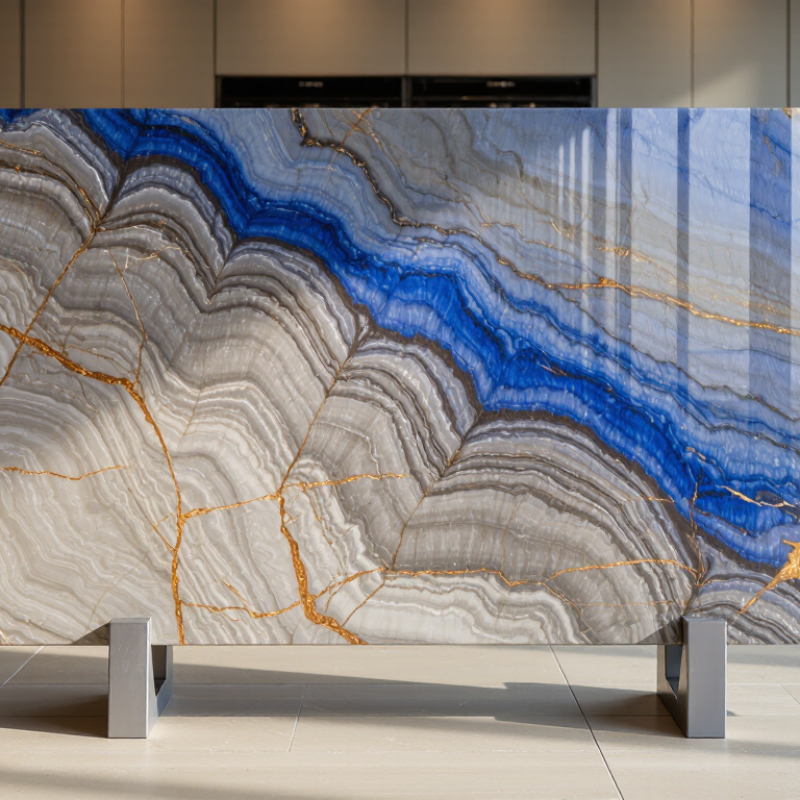
Choosing Azul Macaubas Quartzite requires more than matching a blue color to a design board. This Brazilian natural stone can display vivid cobalt veins, soft gray clouds, and occasional gold movement. Every slab is different. That variation creates character, but it also complicates planning.
The U.S. Geological Survey’s Mineral Commodity Summaries 2025 identifies Brazil as a significant global source of dimension stone. Its reporting supports careful attention to quarry origin and supply consistency. The Natural Stone Institute’s Dimension Stone Design Manual, eighth edition, also recommends evaluating physical performance, fabrication details, and installation conditions. These references provide a stronger foundation than photographs alone. A showroom image is never enough.
For a practical selection, request full-slab photographs, quarry information, and recent test documentation. Review water absorption, density, compressive strength, and flexural strength against the project’s intended use. ASTM C97, ASTM C170, and ASTM C880 provide recognized testing frameworks for dimension stone. Kitchen islands need different scrutiny than wall cladding or bathroom vanities. Edges, seams, sink cutouts, and overhangs deserve close inspection. Small sample tiles may hide dramatic veining. That is easy to underestimate.
Color should be judged under the project’s actual lighting. Place a sample near cabinetry, flooring, and metal hardware. Check it in daylight and warm evening light. No selection is perfectly predictable. Even experienced fabricators can misread a slab’s final visual balance. Therefore, the strongest choice combines verified performance data, an approved slab layout, and a realistic understanding of natural variation. This approach makes Azul Macaubas Quartzite more reliable, expressive, and suitable for the project’s technical demands.
Azul Macaubas Quartzite is a metamorphic stone formed when quartz-rich sandstone recrystallizes under heat and pressure. Its main mineral is quartz, or silicon dioxide, while feldspar, mica, and iron-bearing minerals may create blue, white, gray, or rusty veining. Geological references generally describe quartzite as containing more than 90% quartz, although each quarry block can differ.
The Gemological Institute of America rates quartz at Mohs hardness 7. That makes Azul Macaubas Quartzite notably resistant to scratching from everyday kitchen tools. It is not indestructible. Quartzite may still chip along thin edges or fracture through natural veins. ASTM C170/C170M and ASTM C241/C241M are commonly used to evaluate stone strength and abrasion resistance, but a Mohs rating alone cannot predict countertop performance. This distinction is easy to miss.
Tips: Request the supplier’s current petrographic report and test results for the exact slab batch. Check the surface under bright, angled light. Run your hand across veined areas. Ask how the stone reacts to lemon juice, oil, and heat. Sealing needs depend on absorption, not hardness. The Natural Stone Institute recommends evaluating absorption and stain resistance before final selection. I would also inspect a full slab, not only a small sample. Patterns can change dramatically.
Azul Macaubas quartzite should be evaluated through test data, not color alone. Request an ASTM C97/C97M laboratory report for the exact slab lot. This standard measures water absorption and specific gravity. It does not certify stain resistance or installation quality. Lower absorption generally supports better performance around kitchens, vanities, and humid areas. However, published reports can vary between quarries and batches. Compare percentages tested under the same edition and laboratory conditions.
Thickness affects both handling and visual weight. A 20 mm slab suits many wall applications and lighter countertops, but exposed edges may need lamination. A 30 mm slab offers a stronger, more substantial profile. It also weighs more and may increase cabinet and transport requirements. Large-format slabs reduce visible seams, yet they demand careful access planning. Smaller formats can limit waste on compact projects. Measure elevators, doorways, and turning points before ordering.
Tips: Ask for the absorption value as a percentage, plus the test date and specimen identification. A report showing 0.10% is not automatically comparable with an unreferenced “low absorption” claim. Review seam locations beside the blue veining. I have seen beautiful samples fail as practical choices when access was ignored. Also confirm whether the fabricator recommends sealing after installation. This step is often treated as optional, which deserves reconsideration. Specifications should follow the project’s real exposure, support design, and maintenance expectations.
How to Choose Azul Macaubas Quartzite for Your Project?
Azul Macaubas quartzite can shift from pale blue to deeper ocean tones. View each selected slab in natural daylight, not only under showroom lighting. Place a white card beside the stone to judge its true undertone. Some slabs lean gray, while others show turquoise flashes. The difference may affect cabinets, flooring, and wall paint.
Study the veining from several angles. Long, flowing veins can create movement across an island or feature wall. Shorter lines may suit smaller surfaces with less visual drama. Check whether the veins continue through cutouts and exposed edges. A fabricator should mark sink openings before cutting. This helps preserve the strongest visual areas. It is a small detail, but it matters.
Natural variation is part of the material, not a defect. Compare all reserved slabs together, preferably in the same light. Look for fissures, mineral clusters, cloudy patches, and changes in background color. I once judged a slab too quickly from a polished corner; its center looked much softer in daylight. That mistake was avoidable. Ask for full-slab photographs, but do not rely on images alone. Digital colors can mislead. A physical sample also has limits, because it may show only a quiet section. Leave room for uncertainty when matching multiple slabs.
Assessing color, veining, and natural variation across selected slabs
Each slab is rated on a 1–5 visual inspection scale, where 5 indicates stronger blue color consistency, more continuous veining, and a well-balanced level of natural variation. Review the actual slabs under the intended lighting before making a final selection, because quartzite patterns can vary significantly from one slab to another.
Choosing Azul Macaubas quartzite starts with the fabrication plan, not only its blue veining. The Natural Stone Institute’s Dimension Stone Design Manual, Version 8.2, stresses that natural stone varies in structure and requires project-specific inspection. Ask the fabricator to inspect the actual slab under strong light. Small fissures can disappear in photographs. They may become obvious after polishing.
For most residential applications, 20–30 mm slabs offer a practical balance between weight, edge detail, and structural support. A 20 mm slab needs careful reinforcement around sinks and narrow bridges. A 30 mm slab provides more visual depth, but it increases handling weight. Diamond tools should match each stage: a continuous-rim blade for controlled cutting, a suitable CNC tool for curves, and progressively finer diamond pads for polishing. Dry cutting is tempting, but water-fed cutting usually controls heat and airborne dust better.
Fabricators should monitor respirable silica carefully. OSHA sets an eight-hour permissible exposure limit of 50 micrograms per cubic metre and an action level of 25 micrograms. That figure is easy to overlook. Water management, local extraction, and proper respiratory controls remain essential. I would also request a dry layout before cutting; veining can shift the visual balance dramatically. One limitation remains: no tool eliminates quartzite’s natural weakness. Even experienced teams can misjudge a hidden fracture.
When choosing Azul Macaubas quartzite, request a current ASTM C170 compressive-strength report. The report should identify the tested material, sample condition, test date, and laboratory. Do not rely on a single impressive number. Results can vary between quarry lots and specimen conditions. ASTM C170 measures resistance to crushing under compression. It does not predict staining, scratching, thermal shock, or installation failure. That distinction matters.
Ask how the stone was sealed, tested, and documented. A quality sealer may reduce liquid absorption, but it cannot make the surface stain-proof. Confirm whether the slab arrived pre-sealed or requires treatment after fabrication. Request written guidance for resealing intervals. A fixed calendar may be convenient, yet household use and cleaning habits change the timing. Test a hidden area with a few water drops first. If the stone darkens, it may need attention.
Daily care should remain simple. Wipe spills quickly, especially wine, oil, and acidic foods. Use a pH-neutral cleaner and a soft cloth. Avoid abrasive powders and harsh acidic products. During inspection, check veining, resin-filled areas, thickness, and polished consistency under natural light. I have found that dramatic movement can hide small surface flaws. A sample helps, but it never represents every part of a full slab. Ask the fabricator to review support, overhangs, cutouts, and transport risks before approval.
| Selection Dimension | What to Confirm | Relevant Data or Standard | Recommended Project Record | Decision Guidance |
|---|---|---|---|---|
| Stone Identification | Confirm that the material is sold and documented as natural quartzite, not quartz-based engineered surfacing or another blue natural stone. | Material identity should appear consistently on the quotation, sample approval, slab tags, and technical documentation. | Material: Azul Macaubas quartzite Finish: __________ Slab lot or bundle: __________ | Approve the exact slab or slab lot whenever color, veining, and movement are critical to the design. |
| Visual Variation | Evaluate the background color, blue veining, mineral movement, fissures, and natural inclusions under the intended lighting. | Natural stone is inherently variable; a small sample cannot represent every slab. | Approved slab photographs: Yes / No Lighting reviewed: Daylight / Artificial / Both | Use a layout drawing for bookmatching, vein direction, cutouts, and visible areas before fabrication. |
| Slab Thickness | Confirm nominal thickness and the finished thickness after polishing or edge fabrication. | Common nominal formats: 20 mm and 30 mm Actual thickness must be measured on the supplied slab. | Nominal thickness: ____ mm Measured thickness: ____ mm | Coordinate thickness with cabinet support, edge details, sink installation, and transportation requirements. |
| Compressive-Strength Test | Request a laboratory report for the same material type or, preferably, the same quarry lot and production batch. | ASTM C170/C170M is the Standard Test Method for Compressive Strength of Dimension Stone. It is a test method, not a universal minimum-strength requirement for every project. | Test report number: __________ Laboratory date: __________ Tested value: ____ MPa / ____ psi | Compare the reported result with the structural or project specification. Do not substitute a generic online value for a lot-specific report. |
| ASTM C170 Test Condition | Check whether specimens were tested dry, saturated, or under another condition stated in the report. | Strength results are meaningful only when the specimen condition, loading direction, specimen dimensions, and number of specimens are documented. | Condition: Dry / Saturated Loading direction: Parallel / Perpendicular Specimens tested: ____ | Compare results only when the test conditions and reporting basis are equivalent. |
| Unit Conversion | Use consistent units when comparing the laboratory report with the project specification. | 1 MPa = 145.038 psi 1 psi = 0.00689476 MPa | Reported unit: MPa / psi Converted value, if needed: __________ | Record the original reported value as well as any converted value to prevent transcription errors. |
| Water Absorption and Sealing | Review the stone’s absorption data and perform a sealer compatibility test on an offcut or concealed area. | There is no single universal sealer or fixed reapplication interval for all quartzite. Porosity and sealer performance vary by stone and product. | Absorption report available: Yes / No Sealer test result: Pass / Fail Product and application date: __________ | Choose a penetrating sealer only after confirming compatibility, appearance, curing time, and intended use with the sealer instructions. |
| Sealer Verification | Check resistance to likely liquids such as water, cooking oil, coffee, and acidic beverages using a controlled test on a remnant. | A temporary darkening or ring after liquid exposure does not by itself establish a standardized pass/fail result. | Test liquid: __________ Exposure time: ____ minutes Observed change: None / Darkening / Stain / Other | Use the test result to select the maintenance plan; do not assume that sealing makes the stone stain-proof or acid-proof. |
| Routine Cleaning | Define the daily cleaning method for the completed installation. | Use a pH-neutral stone cleaner, clean water, and a soft cloth or non-abrasive pad. Remove spills promptly. | Cleaner approved: Yes / No Cleaning frequency: Daily / As needed | Avoid abrasive powders, scouring pads, and unapproved acidic or highly alkaline chemicals. |
| Acid Exposure | Identify contact risks from lemon juice, vinegar, wine, acidic cleaners, and other low-pH substances. | Quartzite is generally more acid-resistant than calcite-rich marble, but mineral composition and surface finish can vary. Acid exposure may still affect sensitive minerals, sealers, or contaminants. | High-risk areas: Kitchen / Bar / Bathroom / Exterior Spill-response plan: Yes / No | Wipe acidic spills quickly and never use acidic products for routine cleaning unless specifically approved for the surface. |
| Heat and Thermal Shock | Confirm the intended use near cooktops, fireplaces, outdoor kitchens, or areas exposed to rapid temperature changes. | Natural stone can be affected by thermal shock, existing fissures, resin treatments, and uneven heating. | Application: Interior / Exterior / Wet Area / Fireplace Heat-protection plan: __________ | Use trivets or heat barriers, avoid sudden temperature changes, and follow the fabricator’s installation requirements. |
| Fabrication and Support | Review cutouts, overhangs, seam locations, edge profiles, and cabinet or substrate support before fabrication. | Compressive strength alone does not determine resistance to impact, bending, cutout cracking, or installation damage. | Fabrication drawing approved: Yes / No Support and overhang review: Complete / Pending | Have a qualified fabricator evaluate unsupported spans, narrow sections, sink cutouts, and visible fissures. |
| Acceptance Before Installation | Inspect slabs for cracks, unstable fissures, edge damage, resin-filled areas, staining, and unacceptable visual variation. | Inspection should occur before cutting because fabrication can make defects more difficult to document or resolve. | Inspection date: __________ Accepted by: __________ Defects recorded: Yes / No | Photograph and document any disputed condition before fabrication, installation, or sealing. |
| Maintenance Schedule | Set a maintenance schedule based on use, exposure, absorption behavior, and the selected sealer’s instructions. | Sealer durability is application- and use-dependent; there is no scientifically universal annual resealing rule for every quartzite installation. | Routine review interval: ____ months Re-sealing trigger: Water absorption / Staining / Scheduled review | Re-test the surface when performance changes instead of resealing automatically without checking compatibility and condition. |
Technical note: ASTM C170/C170M provides a standardized method for measuring dimension-stone compressive strength. The applicable acceptance value must come from the project specification, engineer, or authority having jurisdiction; it should not be inferred from the stone name alone.
*$250 Off/Window $500 Off/Door. Minimum of 4 Windows. Max savings not to exceed $2,500. Must present coupon at time of estimate. Some restrictions apply. Cannot be combined with any other offers. Call or see the website for details. www.mpwindowsanddoors.com. Offer Expires 9/30/25. CSLB# 778326. 100% Employee Owned.
Contractor's License CSLB #778326.
© 2000 - 2025 American Vision Windows